
Turquoise: A Stone Formed by Earth, Time, and Meaning

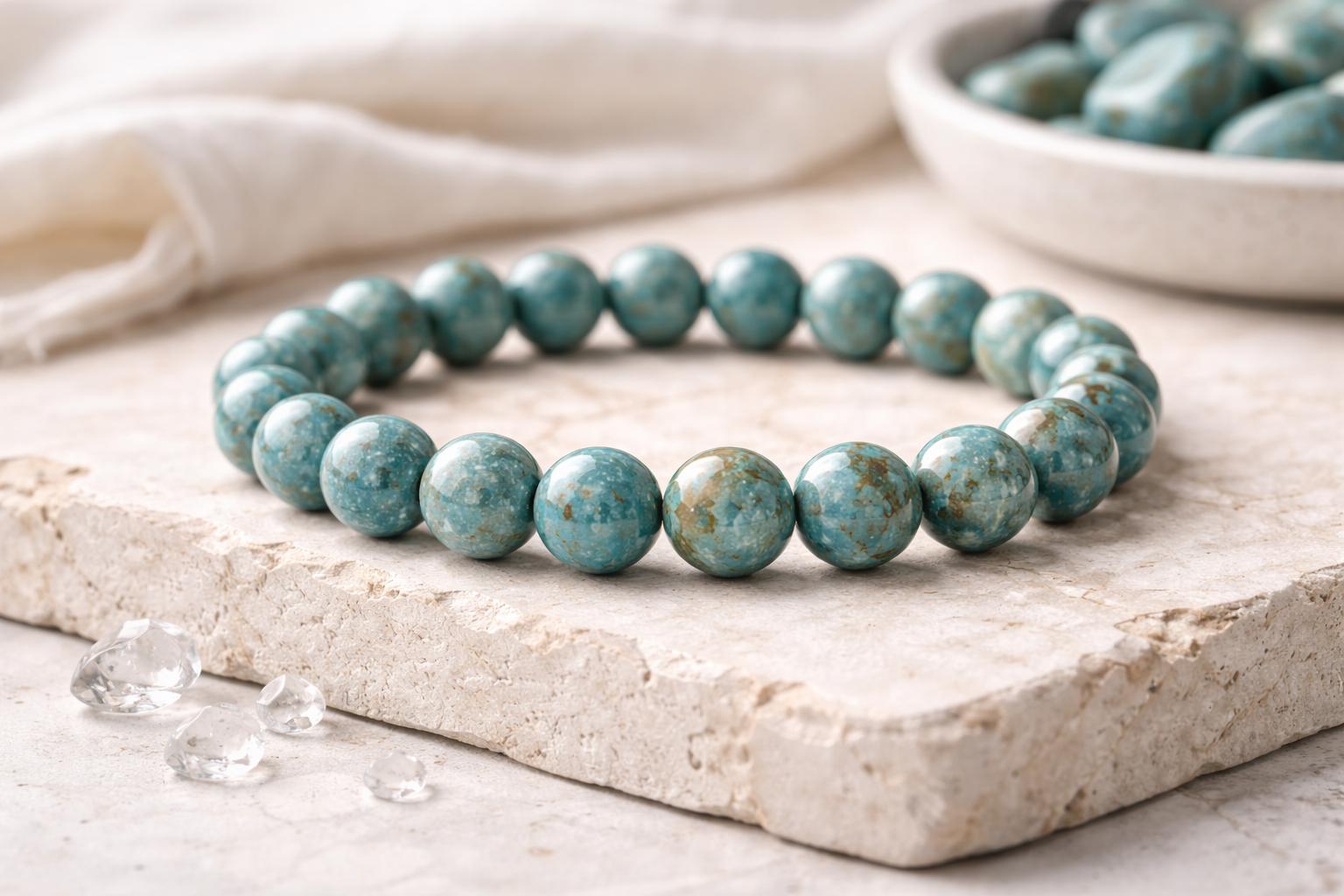
Turquoise is one of the oldest gemstones known to human civilization.
Long before modern jewelry existed, turquoise was already worn, traded, and revered across cultures.
Yet today, turquoise is often misunderstood.
Many people see only its color —
few understand where real turquoise comes from, how it forms, and why authenticity matters.
This article explains turquoise from its roots: geology, origin, and cultural meaning.
What Is Turquoise?
Turquoise is a natural mineral formed through a long interaction between:
- Copper
- Aluminum
- Phosphates
- Water
- Time
It develops underground over millions of years, under very specific conditions.
Because of this natural process:
- No two turquoise stones are exactly the same
- Natural texture and color variation are normal
- Perfectly uniform turquoise is often artificial
Real turquoise is not created in laboratories.
It is shaped by the earth.
Why Origin Matters in Turquoise
In the turquoise world, origin is everything.
Just as wine, coffee, or jade gain value from where they come from,
turquoise is deeply connected to its source.
Some regions produce turquoise with weak structure or unstable color.
Others produce stone that is dense, long-lasting, and rich in character.
This is why experienced collectors always ask one question first:
Where is it from?
Shiyan, China — One of the World’s True Turquoise Origins
Shiyan, located in Hubei Province, China, is one of the most historically respected turquoise-producing regions in the world.
For thousands of years, turquoise from this area has been:
- Used in royal ornaments
- Worn by scholars and spiritual practitioners
- Traded along ancient routes
Shiyan turquoise is known for:
- Natural mineral depth
- Stable structure
- Earthy, balanced tones rather than artificial brightness
Today, many mines in this region are restricted or closed,
making authentic Shiyan turquoise increasingly rare.
Natural vs. Treated Turquoise
Modern markets are flooded with turquoise-like materials:
- Dyed stones
- Reconstituted turquoise powder
- Stabilized or chemically treated products
These materials may look bright at first, but they lack:
- Natural aging
- Mineral integrity
- Long-term value
Real turquoise does not need enhancement to prove itself.
Its beauty lies in depth, texture, and authenticity — not surface perfection.
The Cultural Meaning of Turquoise
Across many civilizations, turquoise has been regarded as a stone of protection and balance.
In Eastern philosophy, turquoise is associated with:
- Grounding energy
- Emotional stability
- Harmony between earth and the individual
Rather than a symbol of luxury alone, turquoise has long been worn as a personal companion stone — something close to the body, carried through daily life.
Wearing Turquoise Today
In modern life, turquoise serves a different purpose than fast fashion jewelry.
It is chosen by people who value:
- Natural materials
- Cultural depth
- Meaning over trend
Whether worn as a ring, bracelet, or bead, authentic turquoise connects the wearer to something older than modern consumption — the patience of the earth itself.
Final Thoughts
Turquoise is not simply a color.
It is not a trend.
It is a natural record of time, pressure, and place.
When you choose authentic turquoise from a true origin,
you are not buying decoration —
you are carrying a piece of the earth’s history.