How to Tell If Turquoise Is Real or Fake

How to Tell If Turquoise Is Real or Fake
A Practical Guide for Global Buyers
Buying turquoise online has become increasingly popular — and increasingly risky.
Every day, buyers search questions like:
Is turquoise real or fake?
How can I tell if turquoise is authentic?
Why does turquoise look perfect but feel wrong?
The fear of buying fake turquoise is a global problem, and for good reason.
This guide explains how real turquoise forms, how fake turquoise is made, and how to choose a seller you can trust.
Why Fake Turquoise Is Everywhere
Real turquoise is naturally rare.
It forms only when copper-rich minerals interact with aluminum, phosphates, water, and time — often over millions of years.
Because supply is limited and demand is high, the market is flooded with substitutes:
Dyed stones
Reconstituted turquoise (powder + resin)
Plastic or composite materials
Chemically stabilized products
Many of these are sold as “turquoise,” even though they are not natural turquoise.
Real vs Fake Turquoise: Key Differences
1. Color Consistency
Real turquoise shows natural variation.
If a stone looks perfectly uniform, neon-bright, or identical across multiple pieces, it is often dyed or manufactured.
Nature does not produce identical stones.
2. Surface Texture and Matrix
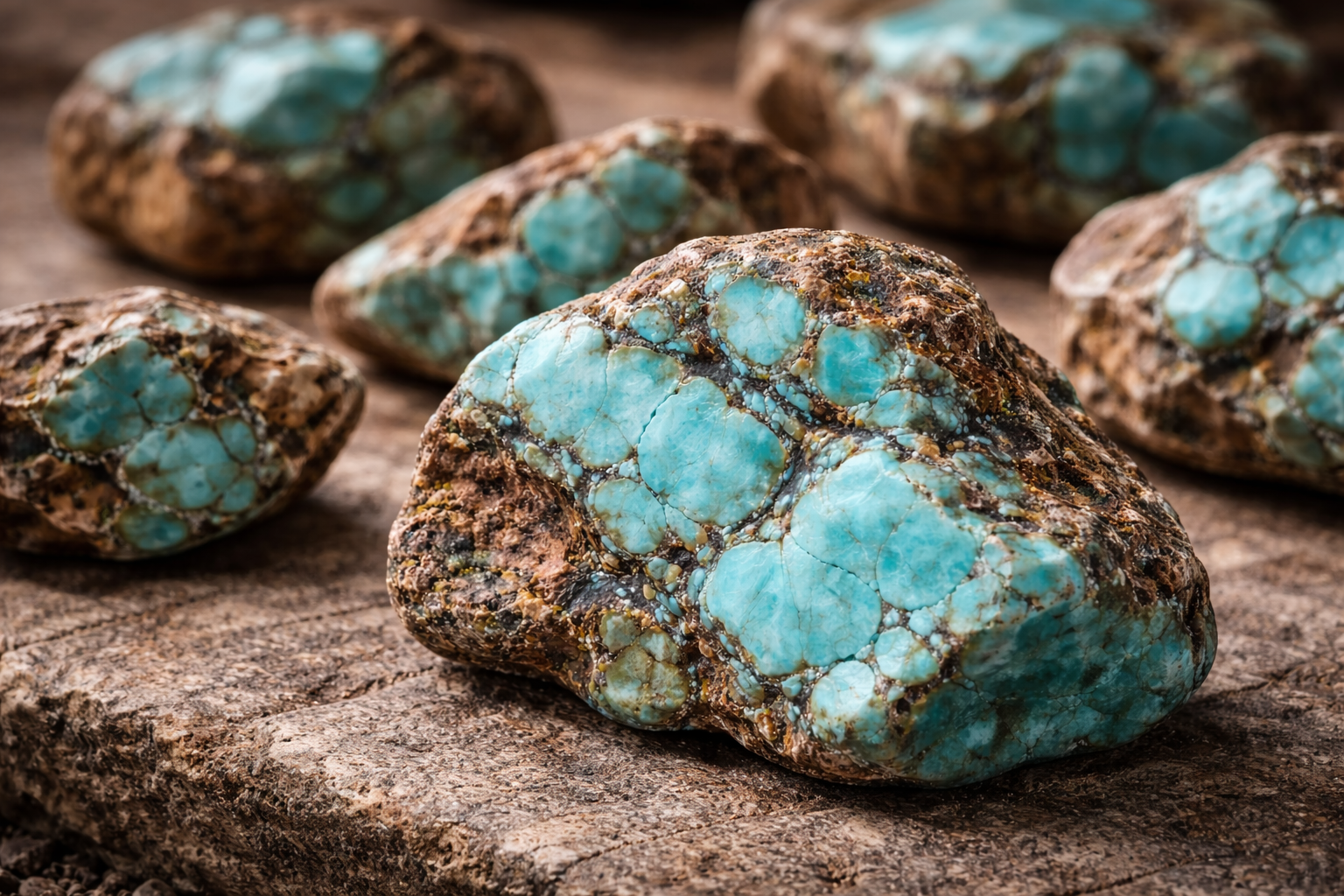
Authentic turquoise often shows:
Mineral veins
Natural matrix patterns
Subtle texture differences
Fake turquoise tends to look flat, smooth, or plastic-like.
3. Origin Transparency
One of the biggest red flags is unclear origin.
If a seller cannot clearly state:
Where the turquoise comes from
What region or mine it is sourced from
Then authenticity is questionable.
In the turquoise world, origin equals credibility.
4. Price vs Reality
If the price feels too good to be true, it usually is.
Natural turquoise from respected regions cannot be mass-produced cheaply.
Why Origin Matters More Than Appearance
Just like wine, coffee, or jade, turquoise gains its value from place.
Different regions produce turquoise with very different qualities.
Some produce unstable stone that fades or cracks.
Others produce turquoise that remains beautiful for decades.
This is why experienced buyers always ask first:
“Where is this turquoise from?”
Shiyan, China: A Historically Proven Turquoise Origin
Shiyan, located in Hubei Province, China, is one of the world’s most respected turquoise-producing regions.
For thousands of years, Shiyan turquoise has been:
Used in traditional ornaments
Worn by scholars and spiritual practitioners
Collected for its mineral stability and depth
Many mines in this region are now restricted or closed, making authentic Shiyan turquoise increasingly rare.
Why Buyers Choose BlueOre
At BlueOre, authenticity is not a marketing claim — it is a sourcing principle.
Our Approach Is Simple:
We work only with natural turquoise, not dyed or reconstructed materials
We clearly state origin, focusing on Shiyan, China
We respect natural variation instead of hiding it
We prioritize transparency over visual perfection
Real turquoise is not flawless — and that is exactly how you know it is real.
Transparency in Cross-Border Buying
We understand that buying turquoise internationally requires trust.
That is why BlueOre emphasizes:
Honest product descriptions
Real photography
Clear communication
Optional shipping or sourcing videos upon request
Trust is built through openness, not exaggeration.
Real Turquoise Is Not Perfect — and That’s the Point
One of the biggest misconceptions is that turquoise should look “perfect.”
In reality:
Perfect turquoise is often fake.
Authentic turquoise shows life, history, and natural character.
At BlueOre, we believe these traits are proof of authenticity, not flaws.
Final Thoughts
Buying turquoise should not feel like gambling.
When origin is clear, materials are honest, and sellers are transparent, confidence replaces fear.
If you are looking for factory-made, identical stones, BlueOre may not be the right choice.
But if you value real turquoise, real origin, and real integrity,
BlueOre exists for you.